HOW CAN YOU PREVENT HAIR LOSS AND THINNING, AND COMBAT BALDNESS?
Updated on , validated by our team of René Furterer experts.
Hair that thins over time, which seems to be more and more sparse, even scattered. Progressive hair loss (also known as androgenetic or androgenic alopecia) now affects 21% of the population, including half of men over 50 years old and 40% of women who are particularly affected after menopause.
What are the causes of progressive hair loss?
Various factors can affect the density of the scalp and the strength of the hair:
age, hormonal variations and heredity. The current health context may also be a factor as 32% of patients who contracted COVID-19 experienced hair loss in the weeks and months following the disease(1). Beyond the aesthetic issue, hair loss can affect morale and self-confidence. That’s why consumers are taking an interest in it earlier and earlier, younger and younger, and are determined to get to the root of the problem to stop hair loss at the first sign. An uncompromising commitment to the effectiveness of formulas but also on the naturalness and eco-design of products!
- reactive hair loss;
- progressive hair loss.
These forms of hair loss do not have the same causes and, therefore, are not treated in the same way. There are different methods to combat these forms of alopecia.
As opposed to reactive hair loss which, as its name indicates, occurs on a one-time basis in response to an event, progressive hair loss sets in over several months and can lead to baldness.
This baldness is characterized by a progressive and more or less localized decrease in hair, giving the appearance of an increasing reduction in the density of the hair mass. The hair thins and becomes sparse.
Prevent hair falling out
BALDNESS AND DENSITY LOSS
The growth phase of the hair is shortened
Progressive hair loss corresponds to a shortening of the growth phase of the hair (the anagen phase) which is linked to a progressive degeneration of the hair follicle.
To understand this phenomenon, it is important to briefly recall how the life cycle of a hair unfolds.
As we all know, our hair is constantly being renewed.

Recognize your hair loss type: is it progressive or reactive?
In everyday speech, we often hear the term " hair loss " used as a generic term.
" I'm losing my hair in handfuls. "
However, there are two types of hair loss that you must know how to distinguish:
What causes androgenic alopecia?
Playing YouTube videos requires the use of cookies in order to offer you targeted advertising based on your browsing For more information, please visit YouTube's « cookie » policy.
You have rejected Youtube's cookies and therefore you cannot view the video.
You can change your choices by clicking on « Cookie Settings » and accept Youtube's cookies to enable the video.
You can change this setting and withdraw your consent at any time.
A hair appears, grows, then dies. And then the hair falls out.
This hair cycle lasts on average 3 years for men and 5 years for women. What is less commonly known is that this cycle is only repeated 25 times. If these cycles keep a regular rhythm, we are supposed to have a "normal" amount of hair throughout our lives.
But, in the case of progressive hair loss, this rhythm is accelerated. Cycles become shorter and shorter, at the risk of coming to an early end.
In fact, once it has reached exhaustion, at the end of the 25 cycles, the hair follicle dies. It resorbs and then disappears.
At this stage, only surgery can provide a solution, a hair transplant, for example. It is therefore important to take alopecia seriously and tackle it as soon as possible: when there is still time to re-grow hair.
Why does hair cycle rhythm get out of control and lead to hair loss?
Androgenic alopecia is the result of an often-genetic dysfunction of the hair and scalp in response to certain male hormones: androgens. This dependency on hormones also explains why the phenomenon of thinning hair only begins after puberty.
Causes of androgenetic alopecia
Testosterone is involved, but indirectly.
To cause hair loss, testosterone must first be converted by 5α-reductase to dihydrotestosterone (DHT).
Hyperactivity of this enzyme leads to an overproduction of DHT, which will cause a shortening of the hair's life cycle and, therefore, an acceleration of the hair's cycles. The hair becomes increasingly sparse.
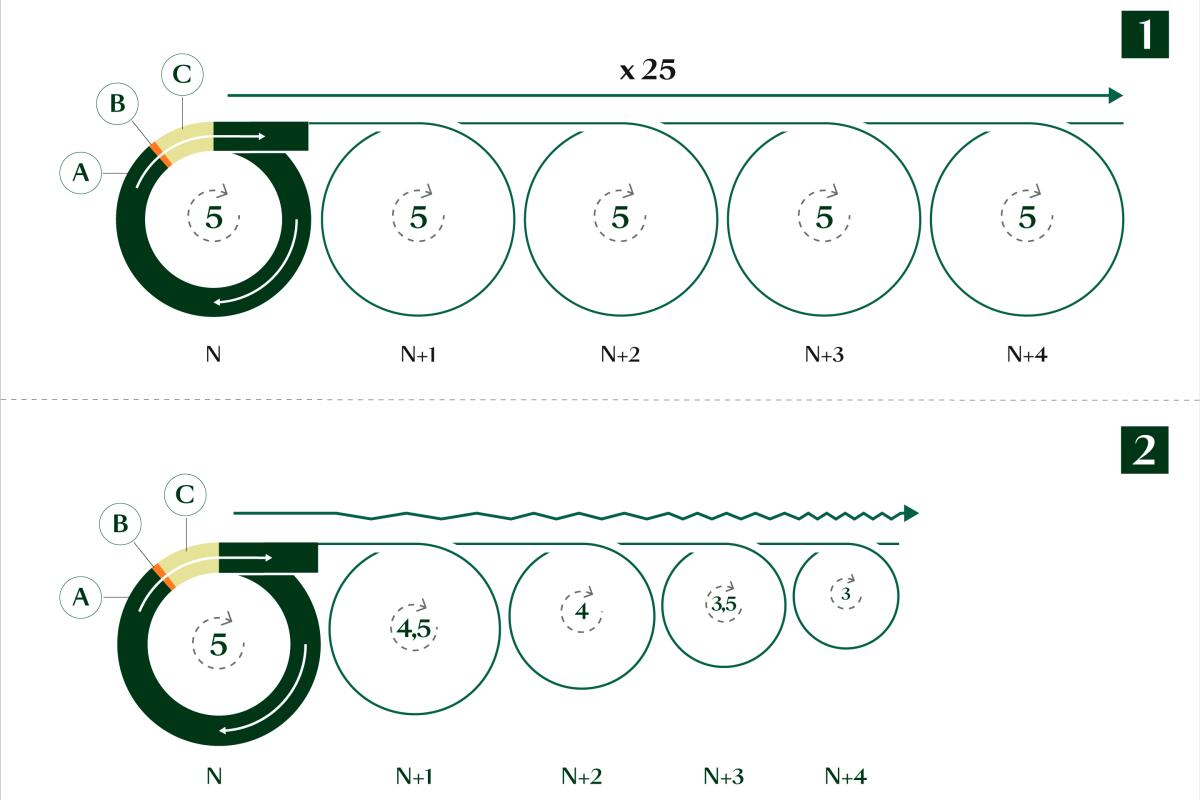
Legend A. ANAGEN PHASE - B. CATAGEN PHASE - C. TELOGEN PHASE
25 cycles on average in a lifetime
1 . NORMAL STATE: The life cycles of the hair follow one another.
N+1, N+2, N+3, N+4... = cycle = 5 years
2 . PROGRESSIVE HAIR LOSS Hair life cycles are getting shorter
N = 5 years
N+1 = 4.5 years - N+2 = 4 years
N+3 = 3.5 years - N+4 = 3 years...
The period of hair production is shortened, the cycles follow each other more quickly, the hair becomes thinner, the follicle becomes miniaturized and exhausted before dying and disappearing.
As a result, the succession of the 25 hair cycles, which is supposed to last a lifetime, ends earlier than expected and can give way to partial baldness, especially at the top of the head, or total baldness.
The other negative effect of DHT is that it also harms the environment around the hair. It stimulates the sebaceous glands which increase sebum production.
When combined, these two phenomena cause weakened hair to fall out before it reaches its maximum length. They then give way to new growth which will also have a shortened life span. The hair grows back thinner, less dense, and shorter.
Playing YouTube videos requires the use of cookies in order to offer you targeted advertising based on your browsing For more information, please visit YouTube's « cookie » policy.
You have rejected Youtube's cookies and therefore you cannot view the video.
You can change your choices by clicking on « Cookie Settings » and accept Youtube's cookies to enable the video.
You can change this setting and withdraw your consent at any time.
Baldness must be tackled at the earliest stage to slow down hair loss
To combat androgenetic alopecia, it is important to prolong the life of the hair by intervening, understandably, before the hair cycles are exhausted once and for all.
The best approach is to prevent hair loss by maintaining and prolonging the anagen phase while stopping the snowballing hair cycles.

To respect the sensitivity of the scalp, and its health in general, it is important to favour treatments based on natural active ingredients such as essential oils and plant extracts.
The naturalness of these products guarantees both optimal efficiency and that your scalp will not react badly.
DISCOVER TRIPHASIC PROGRESSIVE, AN ANTI- LOSS OF DENSITY RITUAL TO COMBAT ANDROGENIC ALOPECIA
TRIPHASIC PROGRESSIVE prevents progressive loss of density by preserving the capital of the roots**.
3 patents for a formula that acts on the quality of hair while promoting the extension of hair cycles.
TRIPHASIC PROGRESSIVE prevents and slows down progressive loss of density by preserving the capital of the roots**.