
How to effectively treat and prevent dry ends
Hair ends are the oldest, and most fragile part of the hair shaft. They are often the first to be affected by dryness, which can lead to split ends. Every day, the ends of our hair are put to the test: straighteners, the sun, frictions against clothes or pillows, frequent washing… To effectively treat and prevent dry and/or damaged ends, there’s one key word: hydration! Let us explore the different causes of dry ends so we can identify the right solutions for you.
Updated on , validated by our team of René Furterer experts.
Causes of dry ends
Internal causes
Hair ends are the most fragile parts of the hair, especially because sebum, which is essential for the hair’s natural hydration, sometimes does not reach the ends.
This is particularly the case with people who naturally do not produce enough sebum, or with wavy, curly, or coily hair whose spiral structure prevents sebum from being distributed evenly to the ends. To make up for these shortcomings, the hair ends need hydration from the right care products, such as hydrating masks and creams, or repairing serums.
Environmental factors
Many environmental factors contribute to dry ends:
- UV rays: the sun’s rays dry out hair, especially the ends. Use a hair sunscreen with a sufficient KPF (Keratin Protection Factor), a sun protection factor for the hair, equivalent to SPF for the skin.
- Chlorine and seawater: swimming in pools or the sea is harsh on your hair, starting with the ends. Rinse your hair after each swim.
- Pollution: airborne particles settle on the scalp, length, and ends, making them porous, drier, and more brittle. Use an anti-pollution treatment to limit the damage to your ends.

Damaging hair habits
Certain actions are too harsh on the hair and can dry the ends:
- Shampooing too often: washing your hair too often strips your hair of its natural protective oils. Space your washes out to avoid weakening your ends.
- Improper washing techniques: remember that you wash your scalp, not your hair. Scrubbing your lengths and ends to create more lather is counterproductive. Instead, massage the scalp and let the foam naturally cleanse the hair as it rinses out.
- Frequent chemical treatments: repeated colouring, bleaching, or perming can damage the hair fibre and leave your lengths and ends dry. Try to space out these treatments or opt for gentler alternatives (plant-based dyes, for example)
- Unsuitable hair care products: using hair care products that do not meet the needs of your hair can damage it. Adopt a routine that suits you: if you have dry hair but use oily hair products, you risk damaging your scalp and lengths with each wash.
- Excessive use of heated tools: the heat of hairdryers, curlers, and straighteners has an impact on the hair, particularly on the ends, leading to dryness and damage. Prefer air-drying as much as possible.
- Regular trims: to prevent your hair from getting weak and damaged, it is important to regularly get it cut by a hairdresser. This will prevent the ends from splitting.
- Inadequately detangling: hair lacking hydration tends to tangle more. To avoid damaging your lengths and ends, make sure to use wide-tooth combs and brushes, and always work from the bottom up.
- Protect your hair at night: at night, your hair rubs on the pillow, causing dryness and breakage. Use a silk pillowcase and braid your hair loosely to avoid these problems.
- Rinsing with too hot, or too cold, water: it is better to rinse your hair with lukewarm water. Water that is too hot opens the cuticles, while water that is too cold can be harsh on the scalp.
How to prevent and hydrate dry ends?
To prevent dry ends, it is essential to adopt a suitable hair routine that allows you to hydrate your hair daily, from roots to ends. This can be done as follows:
- A pre-shampoo to care for your scalp: whatever your scalp’s problems, take them into account: hydrate a dry scalp, purify an oily scalp, soothe an irritated scalp… A healthy scalp is important to provide the necessary sebum right through the ends.
- A gentle shampoo that preserves the scalp’s natural oils. Choose a sulphate- and silicone-free shampoo, as these ingredients are harsh both on the scalp and the hair shaft.
- Apply a hydrating, or nourishing mask after shampooing, focusing on the lengths and ends, providing the moisture and vitality they need. Ceramide-based treatments are ideal, as ceramides are lipid molecules that are highly effective at boosting the hydration of the hair fibre and protecting it from external damage.
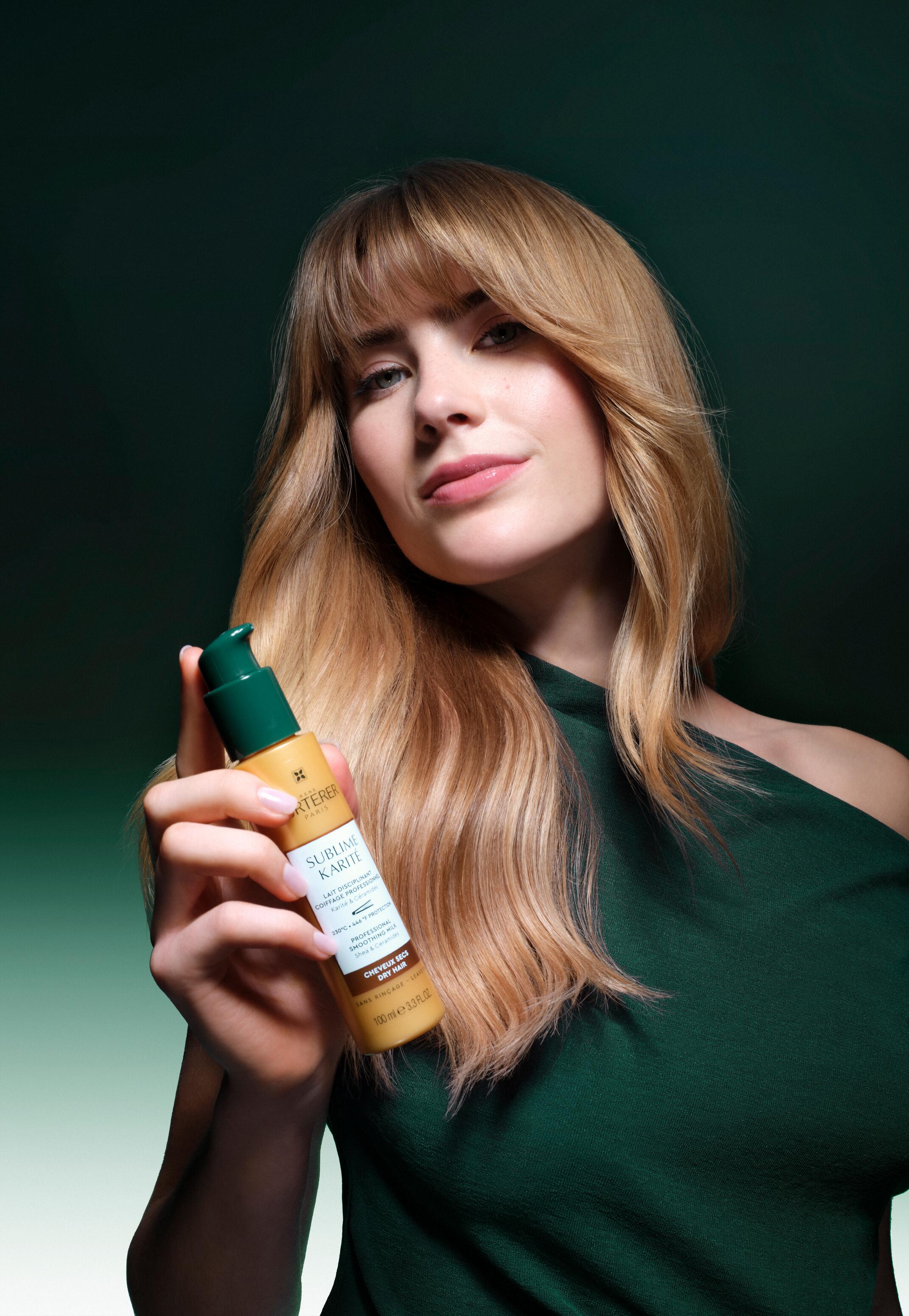
- A smoothing cream for easy styling and deep nourishment. Apply every day to your hair to nourish and smooth the fibre down to the ends.
- A repair serum to treat damaged ends. Also apply daily to repair, protect, and fill in gaps.
Protect dry ends from heat
Use thermoprotective products to limit heat damage
Thermoprotective products are essential if you want to regularly use heated tools on your hair without damaging and drying out your ends. These products are designed to protect the hair fibre from heat damage caused by hairdryers, straighteners, or curlers. As well as acting as heat shields, these products make the hair easier to style and more supple.
Thermoprotective products come in a variety of forms:
- Protection sprays are lightweight and very easy to use: simply spray onto towel-dried or dry hair before using the heated tool.
- Styling lotions protect the hair from the heat while hydrating and taming it. Apply evenly through the hair with your hands.
- Thermoprotective creams for coloured hair meet the needs of coloured or highlighted hair, which is particularly sensitive to heat. Apply to towel-dried, or dry lengths.
- Serums for dry ends focus specifically on protecting this fragile part of the hair strand. Warm a small amount between your hands before applying it to the ends.
Reduce heated tool use
Here are some tips to limit heat damage to your ends:
- Air-dry and style naturally to protect your ends.
- Gently pat your hair with a microfiber towel to remove excess water
- Adjust the heat setting of your styling tools to the lowest temperature to avoid weakening the hair fibre over time.
- Wait until your hair is completely dry before using any heated styling tool to avoid burning your lengths and ends.
Caring for dry ends according to your hair type
Preventing dry ends for coloured hair
Coloured hair is often fragile due to the chemicals used in dyes. That is because the chemicals used in hair dyes are designed to open the cuticles to allow colour penetration, making it drier, especially at the ends, and needing more hydration than other hair types. However, it is important to use products that will not cause the colour to fade too quickly.
What products should be included in the ideal routine to prevent dry ends on coloured hair?
- A sulphate- and silicone-free shampoo for coloured hair to gently cleanse and deeply repair while protecting the colour’s shine
- A mask for coloured hair that restructures the hair fibre, detangles without weighing it down, and hydrates effectively. Make sure to insist on the ends when applying.
- A multi-purpose leave-in cream for coloured hair that protects against heat, hydrates, seals the cuticles, and makes styling easier.
Tips for mixed hair
Mixed hair is characterised by oily roots and dry ends, the sebum production is excessive at the roots, but the ends are sensitive. These are two problems that can be solved with an appropriate routine consisting of three key steps:
- Step 1: a pre-shampoo to purify the scalp. Choose an essential oils-rich treatment to soothe and rebalance the scalp.
- Step 2: a shampoo for oily scalp. Opt for a gentle formula and do not apply on the lengths.
- Step 3: a hydrating conditioner or mask to only use on the lengths and ends. This step hydrates and detangles the hair. Choose a formula that does not weigh it down.
Finally, do not neglect brushing: it helps spread the sebum in excess at the root toward the lengths and ends. However, be gentle to not disturb the sebaceous glands, and avoid breakage.
Spacing out washes to avoid dry ends
Frequent shampooing has an impact on dry ends. How often should you wash your hair to not damage your hair ends? It is recommended to wash your hair 2 to 4 times a week, depending on your hair type. Adjust your routine to your scalp: an oily scalp may require more frequent washes than a dry scalp.
Here are some tips to space out your washes:
- Only use gentle shampoos. Unlike stripping shampoos, which contain sulphates and silicones, gentle shampoos will not harshly strip your scalp. Be gentle when applying and massaging the shampoo.
- Use dry shampoo to help refresh your hair between washes. It instantly absorbs sebum while adding volume. Opt for an unpigmented or nude-pigmented formula for an invisible result.
- Strategically style your hair. Hairstyles like braids or buns can help disguise oily roots. Plus, styled hair tends to hold better when it is not freshly washed.
- Avoid touching your hair too often. This common habit can transfer oil from your hands to your hair, making it greasy quicker.
How often to trim ends?
In general, it is recommended to cut your ends every 6 to 8 weeks. Long, curly hair requires less frequent trimming. However, in the case of damaged hair, it is best to cut the ends more often, every 4 to 6 weeks, to quickly remove the damaged parts, and encourage new growth.